A Steeple in Hollering Distance

Updated: 7 hours ago
Here is the church, and here is the steeple…
I’ve known that little rhyme since I was a child.
And one particular steeple has been sitting in my line of sight my entire life.
This week, I went looking for its story.
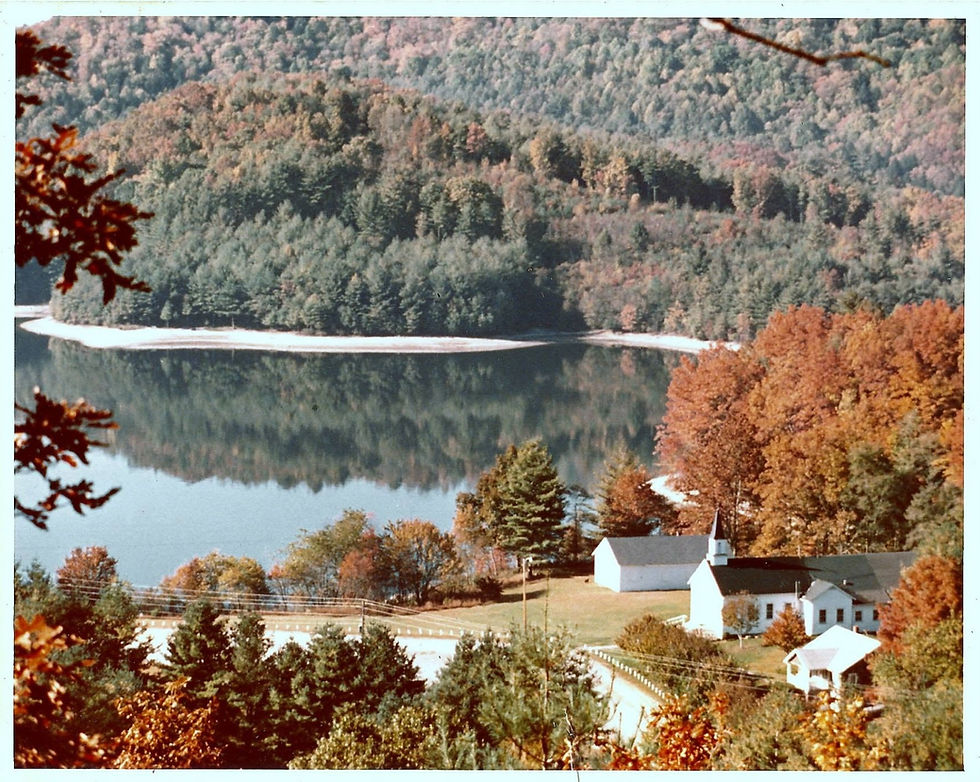
For nearly seventy years, one view from a family porch has held a church that was moved, a lake made for hydroelectric power, a nearly silent highway and more Jackson County history than I understood when I first learned to look at it.
There is a photograph taken from my grandparents’ porch around 1960, several years before I was born, and nearly everything I remember about summers in Glenville is already there — Hamburg Baptist Church sitting below us on the mountain, white against the trees, its steeple rising above the roof and its parking lot curling around it, the water stretching out behind it toward another ridge and then another, and Highway 107 slipping beneath the trees between us and the church so quietly that, if you didn’t know there was a road there, you might miss it altogether.
In those early photographs, you don’t have to look very hard for the steeple. I suppose I’ve been looking for it ever since.
But there is another photograph, taken a few years earlier, that may tell the beginning of our family’s part of the story better. It is 1957. My grandparents have just paid $500 for a mountain-view lot in Glenville, Pappy has built the original summer cabin, and someone has stepped onto that land and pointed a camera toward what no one in our family could possibly have known yet would become our view. The mountains are there, the church is there and the lake is there, except the lake is the newest thing in the picture, because only sixteen years earlier water had begun filling a valley where people had lived, farmed, worshipped, gone to school and buried their dead.
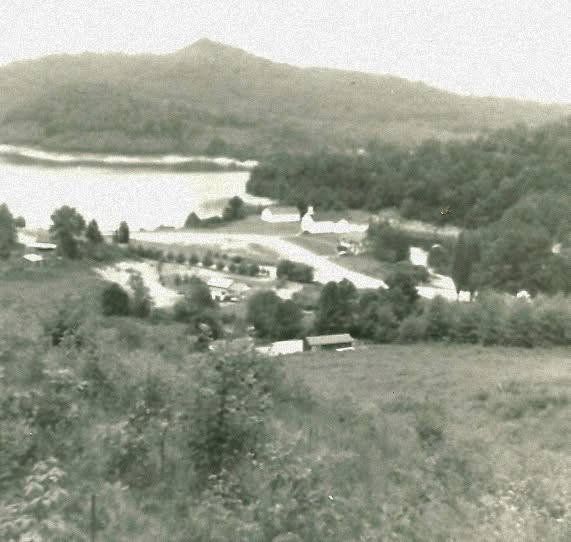
I wasn’t raised believing the lake had always been there. The grown-ups had told me better than that. I knew the story in the shorthand way children often know family history: the lake had been made for hydroelectric power during World War II, and before the valley was flooded, they had moved Hamburg Baptist Church and the cemetery uphill. I knew all of that. I just hadn’t thought very hard about it, because when you’re a child and somebody tells you they moved a church before they made a lake, apparently, you say okay and go swimming and skip rocks.
And we certainly did. There is a photograph of my brother and me in a boat in 1973, two little kids out on the water with the mountains behind us, and although I knew somebody had made that lake before I was born, childhood has its own peculiar measure of time. If something was there before you were, it might as well have been there forever.
The water below us was Thorpe Reservoir, and that wasn’t simply what my family called it. I remember seeing Thorpe Reservoir on paper maps and on the contour map that hung in the original summer cabin my Pappy built. That cabin burned in 2004, and the map went with it.
Around that same time, I had started hearing people around town call the water something else: Lake Glenville. I remember wondering where in the world that came from. No one had told me Thorpe Reservoir had a new name. I just began hearing it in conversation, as though everyone else already knew something I didn’t.
It has taken me more than twenty years to go looking for the answer, and as seems to keep happening while I’m chasing stories for Jackson County’s 175th anniversary, the answer sent me considerably farther back than I expected.
Before there was Thorpe Reservoir, there really was a Glenville.
And then I found Hamburg.
Hamburg wasn’t a new name to me. I grew up knowing Hamburg Township, and with Hamburg Baptist Church sitting below us on the mountain, I suppose I had always assumed the church took its name from the township. What I didn’t know was that before the community I knew as Glenville was Glenville, it had been Hamburgh, and later Hamburg — and Hunter Library’s history says the township took its name from the community, rather than the other way around. WCU Digital Humanities
That stopped me for a minute. Hamburg Baptist Church hadn’t simply been carrying the name of the township all these years. The little white church I had been looking at my whole life had been carrying an older name for the community itself, right there in plain sight.
Postal records show a Hamburgh post office as early as 1856, and the name changed to Glenville on January 29, 1891. Carolana So Glenville wasn’t a name somebody invented for a pretty mountain lake. Glenville was here first.
And then the water came.
The story I grew up with was that they made the lake for World War II, which was the shorthand version, of course, the sort of history families hand down in a sentence or two while you’re riding in a car or sitting on a porch. But when I went looking, I discovered how much history had been tucked inside that one sentence. ALCOA had created Nantahala Power & Light as a subsidiary in 1929 to develop hydroelectric sites in these mountains, construction of Glenville Dam began in 1940, and by 1941 Glenville had added 21,600 kilowatts to a system that previously had only 2,000 — power connected to ALCOA’s wartime aluminum production. WCU
So, the grown-ups were right. The lake below our porch belonged to the enormous demand for power and aluminum that accompanied World War II.
But before the water could come, people had to make way for it, including the church I have been looking at my whole life.
I had always known they moved the church. It has taken me considerably longer to wonder how in the world you move one — or a cemetery, for that matter, or how you decide which pieces of a community can be moved and which ones will simply become part of what people later describe as what used to be there.
It has taken me the better part of sixty years to think about the people on the other side of that sentence — the people who knew where the church had stood before somebody decided where it would stand next, who knew whose people were buried in that cemetery and then watched as those graves and removal stones were moved uphill, who knew where the road used to go and which fields would disappear and what the West Fork of the Tuckasegee looked like before anybody backed it up behind a dam.
They weren’t watching history happen. They were moving out of its way.
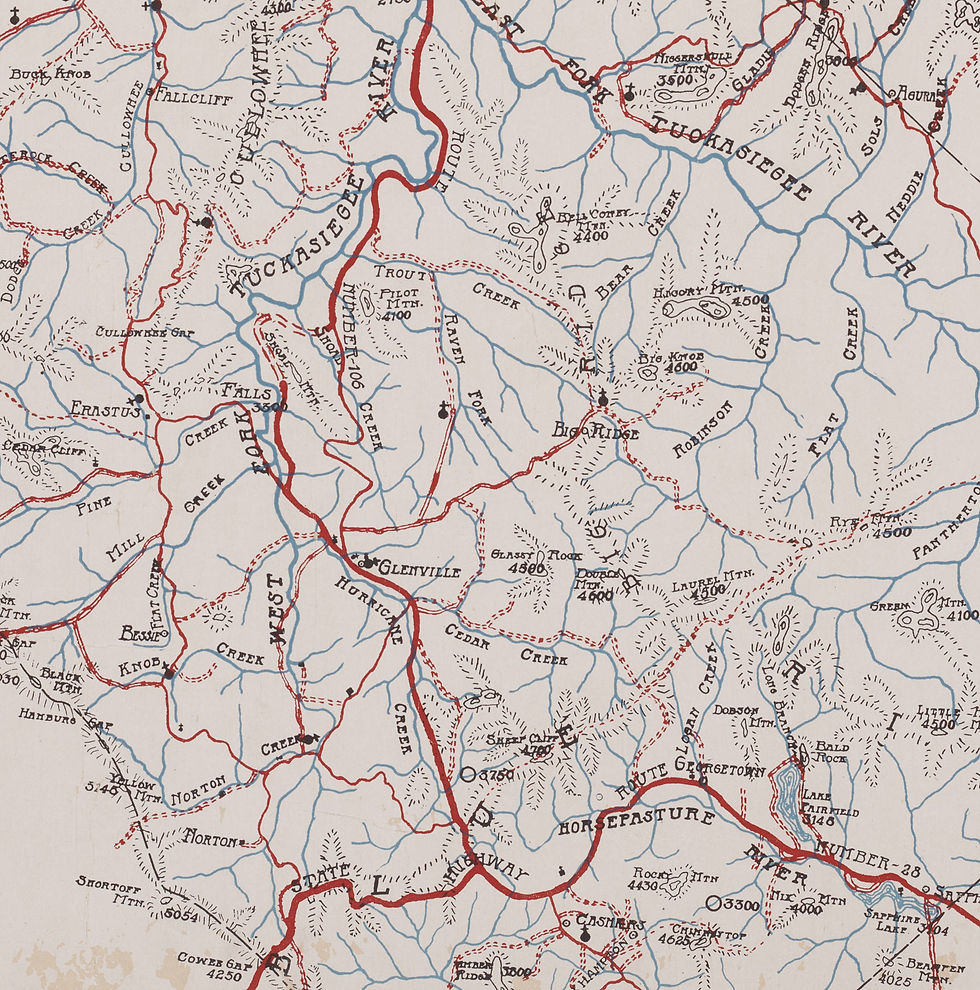
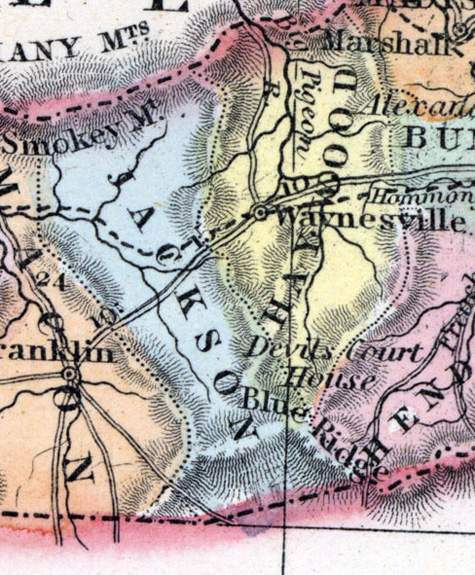
Glenville before the lake. This section of a 1924 Jackson County map shows Glenville and the West Fork of the Tuckasegee nearly two decades before water began filling the reservoir. Courtesy of Hunter Library, Western Carolina University.
And then, within a generation, my brother and I were floating around on top of it.

Maybe that’s what photographs — and old maps — do when enough time passes. They stop showing you only what someone meant to capture and begin showing you things nobody thought needed explaining, because everybody looking at them then already knew what they were looking at. Look at that 1924 map and there is Glenville, the West Fork of the Tuckasegee winding through a landscape of creeks and roads with no lake in sight; look at the photograph from my grandparents’ porch in 1957 and the chronology shifts again, because now my grandparents are the newcomers, the reservoir is only sixteen years old, the church and cemetery have already been carried uphill out of the path of the water, and Pappy is building a little summer cabin on a mountain overlooking a landscape that had already been transformed before anyone in our family arrived.
Even Highway 107 is barely there, which still astonishes me because I don’t remember thinking of us as living beside a highway at all. There were fewer cars, fewer trucks and almost none of the commercial traffic we know today, and 107 tucked beneath the trees so quietly that the road itself hardly registered. I don’t remember hearing the highway nearly as much as I remember hearing the people across it.
One Sunday morning my Pappy and our neighbor LeRoy needed somebody to put on a roof, and rather than open a phone book or start calling around, they called down the mountain toward the people gathering in the church parking lot to see if anybody knew somebody who could do it. Before the sun went down that afternoon, a man had made his way up the mountain to offer his services.
A church that had already been moved once had ended up close enough to our family that we could holler to it. That’s how close we were — not in miles, but in hollering distance.
There was another piece of the old landscape nearby, too, an old root cellar beside the cemetery that I remember throughout my childhood and most of my adulthood, long enough to do what we all seem to do with familiar things and assume that because something has always been there in our lifetime, it will continue being there.
It was demolished only recently.
The lake, meanwhile, had been collecting names almost as steadily as it collected water, and that part of the story surprised me, too. The North Carolina Gazetteer records that it was originally known as Glenville Lake and was renamed in 1951 for J.E.S. Thorpe, the former president of Nantahala Power & Light; other sources document the official Thorpe Reservoir name from 1951 until 2002, when it became Lake Glenville. NCPedia
Friends of Lake Glenville, which was involved in the effort to change the official name, described that change as restoring an earlier name. I don’t remember that campaign, and I can’t say that restored is how the change felt to me.
I don’t remember any of that. I remember Thorpe Reservoir. I remember Pappy’s map. And I remember beginning to hear Lake Glenville around town and wondering where in the world that came from.
Perhaps that’s the part of this story I find most interesting, because history doesn’t always arrange itself as neatly in memory as it does on a timeline. For someone who remembered this valley before the water came, Glenville was a place before it was ever the name of a reservoir; for my grandparents, arriving in 1957, and for the little girl who came along a decade later and grew up looking at Pappy’s contour map, the water was Thorpe Reservoir; and for someone arriving today, it has probably always been Lake Glenville.
Same water, different names, and depending on when you arrived, a different memory of what had always been there.
There is another photograph from our place, taken in 2013, and by then the trees had grown so tall that much of the view my grandparents photographed in 1957 had disappeared behind them. The lake still peeks through, and the mountains are still beyond it, but somewhere among all that green is a little white steeple you have to know where to look for.

Highway 107 isn’t silent anymore. The root cellar is gone. Pappy’s original cabin and the contour map that named the water below are gone, too. The lake has another name, and the trees have grown into a view that once stretched almost uninterrupted from our porch toward the water.
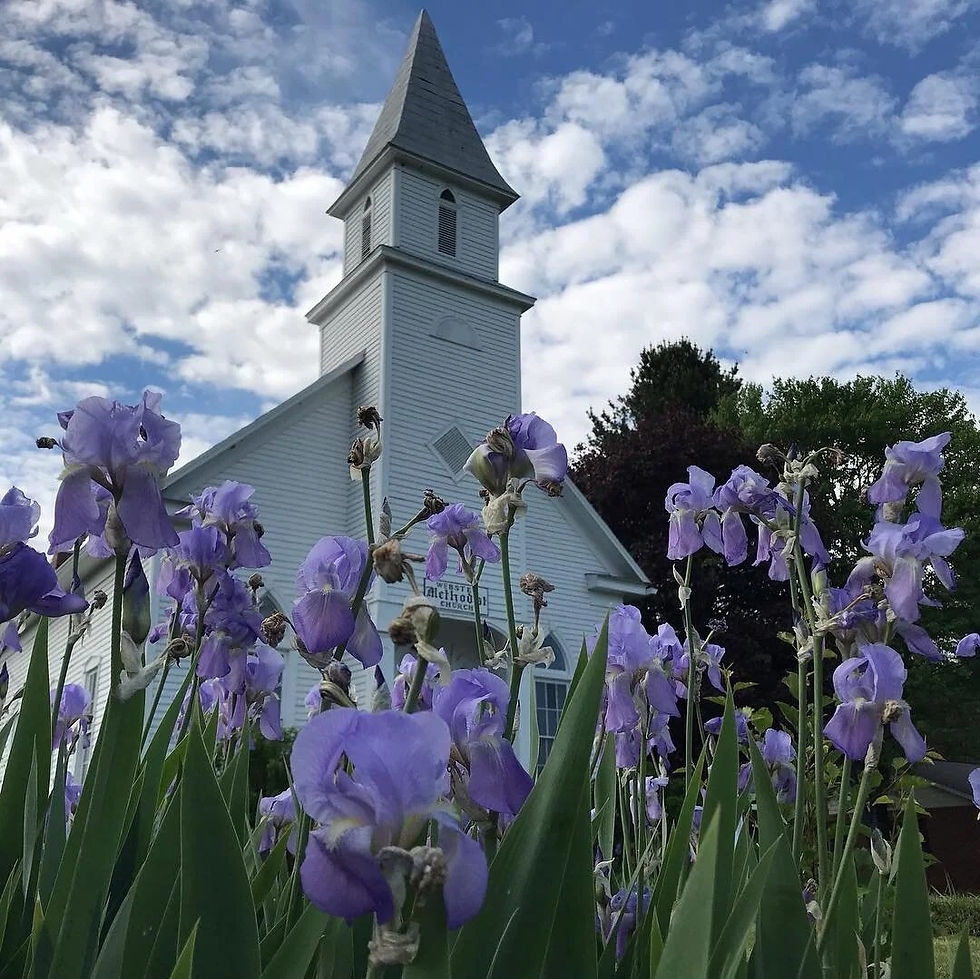
But Hamburg Baptist Church is still there.
And now, when I stand on that porch and find its steeple through the trees, I think differently about something I accepted without much thought as a child: a church that had already been moved once ended up close enough to my family that we could holler to it.
Nearly seventy years later, the Hamburg church and our porch are still in hollering distance.
And I still know where to look.
I’ve been looking for that steeple my whole life.
Comments